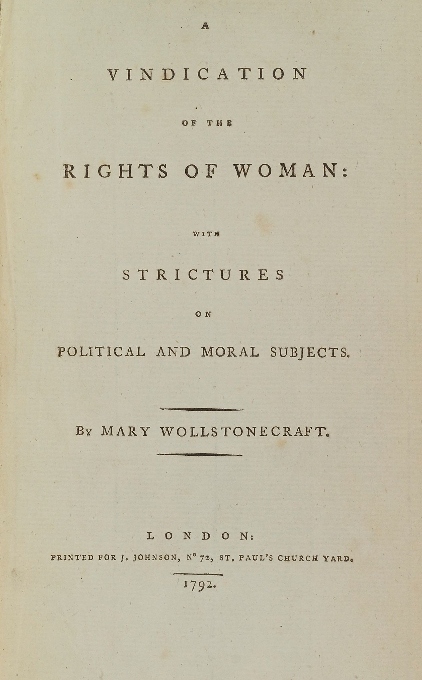
Anyone with an interest in feminism and its history should read A Vindication of the Rights of Women at some point. The extent to which Mary Wollstonecraft was ahead of her time is amazing, and she makes a compelling argument about how women are not in any way mentally inferior to men, or even largely that different, but are lead to develop in certain ways due to the education that they receive or by how they are influenced by others in their life.
Of course, despite the growing misogyny of our times, this stance is still something which is taken as a given by experts these days – but for someone writing at the end of the 18th century, this is impressive stuff, and you can see that Wollstonecraft was one of the giants upon whose shoulders many of the most influential feminists of the last couple of centuries have stood. This was before “feminism” even really existed. She even challenges a lot of prominent thinkers of her time, like Jean-Jacques Rousseau, who had made unhelpful arguments about the status of women in the past. I particularly enjoyed her criticisms of John Milton’s description of Eve, which I just so happened to read just before this text.
You can also see her progressive values in her anti-monarchy perspectives. She rightly identifies that some of the poor treatment of women in the world occurs as a consequence of thought processes which are inherited by those who put monarchs onto a pedestal. She also identifies that people’s religious beliefs might feed into this too – although she is very notably writing from a religious perspective and regularly ties her beliefs about women into her perception of God, which may seem unusual to some modern readers. For me, I just felt that it gave it a unique sort of flavour when compared to more recent texts.
There is, however, some stuff that really didn’t age that well and seems to be born out of a misplaced sense of propriety that people had back when she was writing. Part of it, for example, has her talking about how she has known women who would wash or get changed in front of each other, and she sees this as a lack of modesty which women have because they have been treated as lesser all their lives. From my modern perspective, I think, nobody should feel uncomfortable about doing these things around other people if everyone’s fine with it. Meanwhile, at one point, she talks about a woman talking about indigestion, and says that this similarly shows a lack of self-respect caused by the treatment of women. This sort of attitude is genuinely harmful, because people need to feel comfortable talking about any and all health problems so that they don’t feel ashamed about seeking treatment – especially with women disproportionately not receiving proper care.
Nonetheless, I do not expect perfection from somebody who wrote so long ago. It’s important to identify the problematic elements that she inherited from her time, but generally speaking, there are a lot of reasons to be impressed by Mary Wollstonecraft and this remains a fascinating historic text. It can be very dry in the latter half, but it’s not long overall, so I definitely recommend it.
Rating: 8.3/10