Sonic the Hedgehog (Archie Comics) #1 – 25

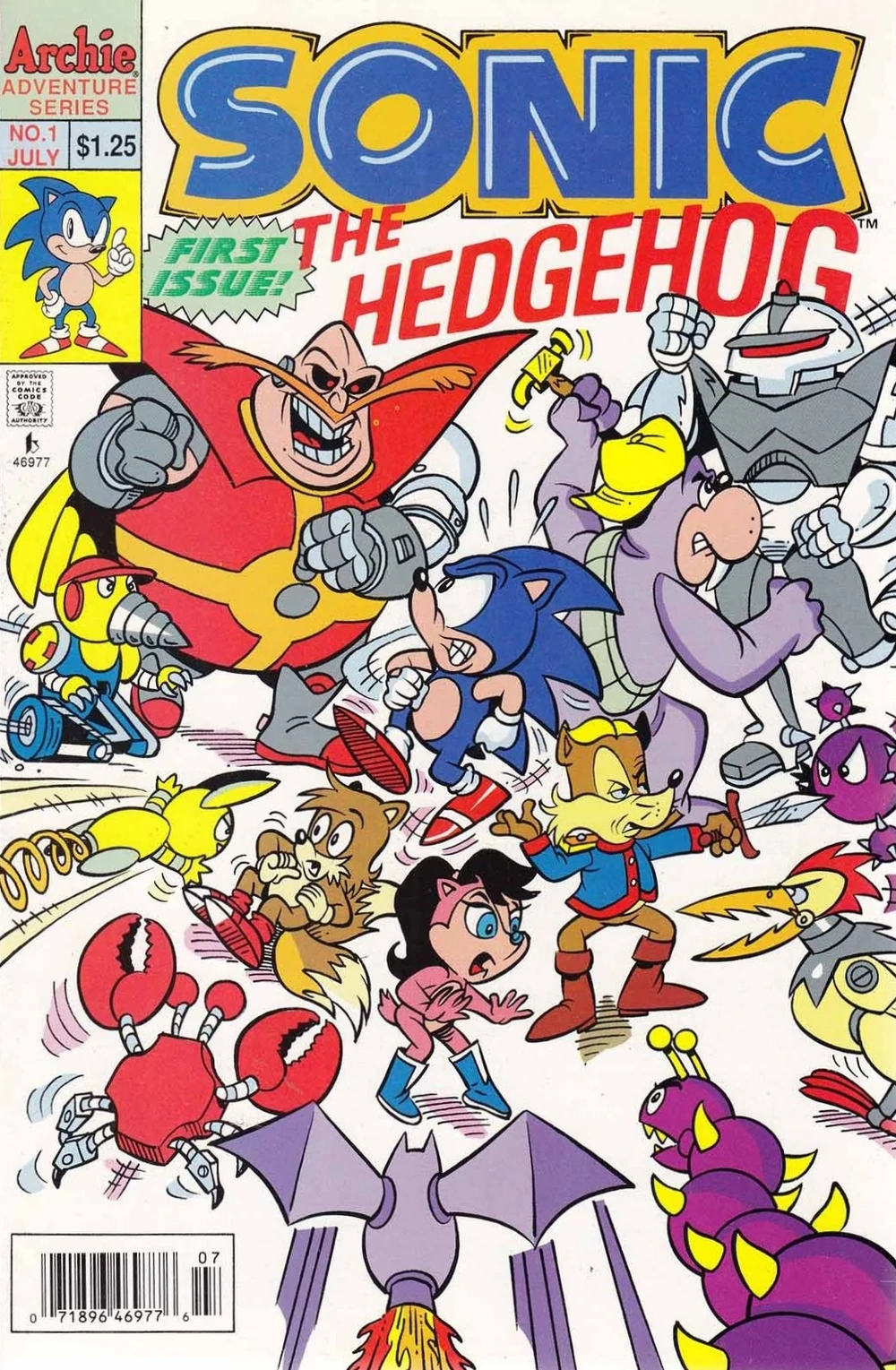
For years, I had heard things about the Archie Comics Sonic the Hedgehog series. People always spoke about how dark and edgy it was, and how it had overly complex storylines. I was very curious, particularly as I enjoy dark stories about light-hearted characters and am quite a Sonic fan. Recently, I finally got around to read it. Knowing there are so many of them, I read the first twenty-five in one chunk.

What was particularly surprising to me was the fact that, at first, it was very much one of the most slapstick interpretations of Sonic the Hedgehog that I’d come across. It was full off fourth wall-breaking joke, silly puns, and was generally just a series of very low stakes adventures for Sonic and his friends. I actually found a lot of them quite funny.

Generally speaking, they all deal with Sonic and friends (the Freedom Fighters) coming up against Robotnik in some form or another, but it slowly started to get more interesting – which is good, because it otherwise would have gotten old fast. One story showed countless different versions of Sonic from throughout the multiverse – one of which was an evil character called the Anti-Sonic (who become a recurring villain). Another saw Robotnik and the Freedom fighters somewhat on the same side as the came up against an alien foe.

Some of the comics are adaptations of the games too. Of course, back when this comic was coming out, the storylines of the Sonic the Hedgehog games were much more vaguely defined, meaning that they were still somewhat open to interpretation and it’s interesting to see how the writers on the comic interpreted things a differently to the mainstream interpretation you see in the modern games.

Speaking of which, I enjoyed the expanded cast of characters here, like Sally Acron as the leader of the Freedom fighters, Rotor as their tech guy, Bunnie a partially robotised rabbit character, and Antoine as a kind of stuck-up comic relief (who I think Sonic is actually kind of unfair too). Tails is also there, but he’s the only regular Sonic character that fans will recognised from the modern-day cast.

My absolute favourite aspect of the story, and the thing that was closest to being ‘dark’ or ‘edgy’ was the introduction of Sonic’s Uncle Chuck and his old dog. These characters were captured by Robotnik and turned into robots, which I thought was really sad and works well as a motivation for Sonic, while also serving to show that Robotnik really is capable of doing some pretty horrible things.

As a Sonic fan, I definitely enjoyed what I read of this comic and I will be reading more in future. I’m quite optimistic about the storylines I have yet to read and I think this is a pretty good start to the series. My only real criticism is that the fat jokes about Robotnik didn’t really age so well.

Rating: 8.2/10

Facebooktwitterredditpinterestlinkedinmail
Posted in Book Reviews | Leave a comment

Assassination Classroom, Volume 11 by Yusei Matsui

Diving into the eleventh volume of Assassination Classroom, it was noticeable that this was something of a breather entry. That’s not to say that it wasn’t enjoyable or important to the overall storyline, but there were certainly fewer major developments in this one.

The first part of the storyline is about the student Isogai. We get a glimpse into his personal life and find that he has a part-time job outside of school… something which goes against the school’s policy and ultimately endangers his position their. Class A want to blackmail him and in order to protect their classmate, they end up doing battle in a competitive school event.

It’s fun to read, and it’s nice to get a little bit more character development for Isogai, but the school event feels like the kind of thing you’ve already seen before at this point. There’s slightly less focus on Koro-sensei too, which is a pity, because he’s the biggest start of the manga for me.

After that, the second half of this is about the students doing a bit of community service in order to repay an old man who they inadvertently injured during some out of school training. This then sees them looking after a group of younger children and learning a bit of responsibility. Fun, with some sweet moments, but again, nothing extraordinary – although I did love Koro-sensei’s interactions with the old man. His weird human disguise is funny.

A good volume, for sure, but nothing groundbreaking.

Rating: 8/10

Buy it here.

Facebooktwitterredditpinterestlinkedinmail
Posted in Book Reviews | Leave a comment

The Secret Garden by Frances Hodgson Burnett

I love stories that are set in slightly spooky old estates out in the moors, and The Secret Garden is a perfect example of that kind of book. It starts out in India, but I won’t spoil exactly what happens, as it was very dark, and very unexpected, but once it gets into it, a girl named Mary Lennox is adjusting to a new life in a solitary home in the Yorkshire moors.

As you might have guessed, this home contains a secret garden, but I don’t want to say much about it, as there are lots of little twists and turns. At its heart, it’s really about the blossoming childhood friendship between Mary, a boy named Dickon, and another boy called Colin. They all change and grow from their relationship, and having that at the heart of the story is very wholesome.

Another aspect that was very appealing to me was the fact that the story has a fantastic atmosphere – the old house out in the moors comes across so clearly, and the aura of mystery pervades the whole thing. If you’re somebody who loves nature, and stories that capture its beauty, then that’s one aspect of The Secret Garden that will be particularly appealing.

Not only does this book do a good job of showing how untampered wilderness can actually be quite daunting, but it also shows how it can be something that’s very comforting. Dickon in particular was quite a likeable character, because he perfectly embodies the idea of being at one with nature – perhaps in a slightly over the top way, but then again, it is a novel for children. I was particularly pleased with his ethos of respect for animals, which seems quite rare in other work of the time.

One aspect that I didn’t so much enjoy was one that seemed to have the angle of “The chronically ill have willed themselves into that position”. It’s a complicated one though, because I know that there are instances of a person believing they’re unwell to the extent that it can make them unwell, but I also feel like because this is such a common narrative in stories like this, it’s actually quite harmful, because those who are genuinely unwell have people acting like this is the case. It’s of a time, and medical knowledge was much more limited back then, so I can forgive it, but in the grand scheme of things I don’t think it’s a helpful narrative.

My only other gripe with it, is that it seemed to end a little suddenly. I guess I’m used to books of that era giving loads of detail about the characters’ lives beyond the main events of the novel, but with this one, I was genuinely surprised that the last chapter was the last chapter (I was reading an ebook). This was particularly true for the character Martha (a servant who Mary befriends) who plays fairly important role in the book, but whose last appearance is so incidental, you’d never think that you wouldn’t see her again.

Nonetheless, I don’t want to end this review on a negative note, because it’s a sweet little book and I’m glad that I read it. It’s a delightful children’s novel that tells a moving story about crawling out of a pit of despair and isolation, and finding new happiness through the power of friendship and the majesty of nature.

Rating: 7.9/10

Buy it here.

Facebooktwitterredditpinterestlinkedinmail
Posted in Book Reviews | Leave a comment

I Capture the Castle by Dodie Smith

Set in an abandoned old castle, I Capture the Castle is the story of two sisters (Cassandra and Rose), their father, Mortmain, a struggling writer, his wife, Topaz, a nude model, and their servant, a young man named Stephen. Though you’d expect anyone living in a castle to be pretty well-off, they’ve leased it and barely have any money at all, because while Mortmain once wrote a really successful novel, he’s never been able to come up with a second, and he struggles to come up with anything else through fear of reaching the same levels of success.

The whole book is the diary of Cassandra and she’s a very believable (and likeable) teenage character. Sometimes she comes across as a little too melodramatic, but then, what teenager isn’t melodramatic from time to time? But even though she can be a bit gloomy, the book does a really good job of capturing the feeling of being an older teenager on the cusp of becoming an adult. There’s a charming joy and brightness to it all.

You could say that Cassandra is in the spring of her life, and I feel like this book embodies spring in a lot of ways. Though the book spans through spring, summer, and autumn, there are a lot of scenes of the characters enjoying themselves on sunny days around the village in which they love. The setting of the book is really beautiful – the castle comes across so clearly and the author does such a good job of creating vivid images of the quaint English countryside. Meanwhile, she also goes into a lot of detail about the history of the castle they live in, that helps it feel very rooted in history in a way that I really enjoyed.

Contrasted against that though, are the two American men: Simon and Neil Cotton. Having seen so little of the world, Cassandra (and her sister Rose) are both really taken with their pair of them. While they have some rather toxic attitudes (mostly Simon), the girls in their naivety don’t notice these warning signs (and, I guess, also, it’s the 1930s). Being written entirely from Cassandra’s perspective, it’s interesting to see how her thoughts and perspectives change – it helps make it more realistic.

On that note, I won’t spoil it, but the novel ends when Cassandra decides to stop writing in her diary. Initially, I was disappointed by this, because it felt a bit underwhelming, but as time went by, my opinion of it slowly changed – thinking more and more about it, it felt very true to life, and though it is a bit open ended, it does leave room for you to interpret events in whatever way is most appealing to you.

There were a lot of things that I really enjoyed about this book. I felt I really got to know and like Cassandra – meanwhile, I also really liked her sister Rose and I was quite invested in the relationship between them. Their father, Mortmain, though kind of obnoxious, was also quite an interesting and eccentric character. Topaz and Stephen are both really strong, likeable characters as well, and I was particularly moved by Stephen towards the end. Ultimately, a book that creates such a beautiful setting that you can imagine so clearly and fills it with a cast of characters you’re properly invested in, is a book that’s definitely worth reading.

Rating: 8.6/10

Buy it here.

Facebooktwitterredditpinterestlinkedinmail
Posted in Book Reviews | Leave a comment

Aesop’s Fables

Aesop’s Fables are stories that are such cornerstones of our culture – small tales that have gone so far as to become part of our everyday language. I always find myself saying things like “slow and steady wins the race” referencing The Tortoise and The Hare, or “it’s a boy who cried wolf situation” referencing the story of the same name. If Aesop was indeed a real person (and that’s up for debate) he was an absolutely genius for coming up with stories that resonate so deeply (and even if he was real, we don’t know if the alleged Aesop came up with these stories himself, but I digress).

With such a collection of bite-sized stories, it’s easy to find the time to read one before bed each night and that’s exactly how I read Aesop’s Fables on my most recent read-through. Knowing just how old these stories are makes them so much more appealing to me, and it’s amazing to think about how long they’ve survived and for how long they’ve been giving people ways to interpret and understand things.

In addition to the two mentioned above (my two favourites), I was also very fond of The Lion and The Mouse, where a lion spares a mouse, who is later able to return the favour by gnawing through ropes that bind the lion, and there are plenty of others that are quite clever or poignant – but then there are quite a lot of them that don’t really have a good message at all.

Of course, these stories are thousands of years old, so it’s understandable that many of them might not have aged so well, but a common theme was that people ended up meeting with a bad fate if they ever hoped for anything more in life. ‘Know your place’ and ‘be grateful for what you have’ were common messages, and while I do think it’s good to encourage appreciation for the things you have in life, a lot of them had people ending up dying for ever trying to get something more for themselves, and I think that’s a bit of a rubbish message.

So while it can be quite clever at times, I think it’s best appreciated as a collection of historically significant stories. I still recommend this because the influence of these fables is enormous, but I wouldn’t recommend them as useful moral lessons for children.

Rating: 7/10

Facebooktwitterredditpinterestlinkedinmail
Posted in Book Reviews | Leave a comment

Middlemarch by George Eliot

Middlemarch is one of those books that is highly regarded as one of the best of its era, but having read it, it’s certainly one that might not appeal so much to the modern reader. I definitely enjoyed reading it, but it’s quite a slow read, and one that has a number of different story threads that you need to keep on top of. It’s definitely not one to read if you’re not used to the classic novels of that era.

The story is all about a small town called Middlemarch (hence the title) and it tells you about the lives of several different people who live there. At first it tells the story of two sisters named Dorothea and Celia Brooke who live with their uncle and who encounter several men/potential husbands. Then after a little while, it shifts perspectives and you learn about a man named Fred (who’s considered to be something of a failure) who’s trying to woo a lady named Martha, and then also a man called Tertius Lydgate who comes to Middlemarch to open up a doctor’s surgery.

A lot of the time, it might feel a little aimless. The characters go about their lives and have their own little dramas and developments, but it doesn’t feel like a cohesive novel that’s moving towards anything in particular. With a lot of novels, you know what it’s all leading up to, but with Middlemarch, there’s no clear endpoint. This isn’t a criticism by any means, just a description of what makes it unusual, though I appreciate that this will be off-putting for some readers.

As for me, I appreciated the slow-burn way in which I got to know all of the characters. Lydgate and Dorothea in particular were two who left a very positive impression on me. Both of them have relationship troubles and, in many way, their experiences mirror each other. There’s a clear journey of character development for them both, with Dorothea becoming less naïve in a positive way, and learning to better understand people and the world, and Lydgate become less naïve in a negative way, and hitting some very hard times after things don’t work out as he hoped. I love Dorothea’s growing sense of independence and maturity, and I loved Lydgate’s short, but well-meaning manner of speaking to people. It was a pleasure to get to know them both.

I have to say though, that this is a fairly long book, and there were certainly times when I just found myself hoping for a chapter to end, because it focused on things that just felt very mundane. That’s not to say that there weren’t some great character moments, and even shocking revelations, but other times chapters seemed to focus on people who were just living their regular lives, and it could be a bit grating, especially when it has quite a large cast. I wasn’t equally invested in all of them, so it was a shame when one of the more uninteresting or unlikeable characters took the spotlight for a while.

Still, George Eliot has done a fantastic job of creating a community of characters with unique motivations, histories, and personalities. The way in which their lives intersect was often as satisfying as reading a crossover. It isn’t one of my favourite classics, but I am still glad that I read it.

Rating: 7.3/10

Buy it here.

Facebooktwitterredditpinterestlinkedinmail
Posted in Uncategorized | Leave a comment

Four Doctors by Paul Cornell

After Clara Oswald discovers a photo of the Twelfth, Eleventh, and Tenth Doctors together, she takes steps to try and stop them from ever meeting, fearing that their coming together would be the catalyst of a terrible disaster. In the process of trying to keep them apart, however, she accidentally plays a part in bringing them together.

I think that’s all I’ll say about the overall story, because there are so many little twists and surprises, that I think it’d be best for fans to enjoy it as intended. Paul Cornell is, in my opinion, one of the best writers to ever write for Doctor Who, because he always manages to tell really amazing stories that maintain a really strong emotional centre, and this is no exception.

This is a story that’s set during Series 8 for the Twelfth Doctor and Clara – this was a fantastic series and Four Doctors fits in really well into it. Indeed, it ties in very cleverly with one of the most emotionally impactful moments of that series (which I shan’t spoil), but, gosh, is it powerful (and sad). It dives deep into the mind of the Twelfth Doctor (my favourite one) and does so just as well as any of the best TV episodes from his era.

Meanwhile, it’s also great to see the Tenth and Eleventh Doctors interacting with the Twelfth. They are both suspicious of him, because they don’t believe there’ll be any incarnations after the Eleventh, thinking that he might even be the Valeyard, with the Twelfth Doctor’s antagonistic behaviour not helping matters. It makes a great dynamic, and they’ve all been written brilliantly.

On top of that, the story provides a glimpse into timelines which show how things may have altered if each of the Doctors in the story had made the wrong decision at particularly sensitive moments – my favourite was the scene that showed a particularly sinister look at the dark side of the Tenth Doctor. On the flip side of that, I found the Eleventh Doctor especially charming in this comic – moreso than I usually do on television. Everyone is characterised perfectly.

While the story is primarily focused on the “new” era of Doctor Who, it does still contain some nice connections with the classic era of the show – specifically by featuring the Voord, the enemies from the story The Keys of Marinus. If you’ve never seen it, don’t worry – I had never seen it when I first read it and it’s really not essential to understanding or enjoying the story. Indeed, the TV story itself doesn’t do much to develop the Voord or make them interesting.

All in all, it’s one of the best Doctor Who comics I’ve ever read and one that I recommend highly. If you’re a fan, there’s so much to enjoy in it.

Rating: 9/10

Facebooktwitterredditpinterestlinkedinmail
Posted in Book Reviews | Leave a comment

The Great Hunt by Robert Jordan

This is the second book in The Wheel of Time series and it picks up shortly after the end of the first one – and indeed, I think it captures much of the same charm and appeal as the first book, so it’s definitely a sequel you’ll want to come back for.

There are two main story threads in this one that run parallel – the first of which sees Rand, Mat, and Perrin chasing after the forces of Padan Fain after he steals Matt’s dagger, as well as a legendary artefact known as the Horn of Valere, which when blown will supposedly summon the heroes of the past. Meanwhile Egwene and Nynaeve train alongside new friends as they study to become Aes Sedai. Both threads were interesting to me, and I enjoyed getting to switch between them.

The biggest downside was that Moraine and Lan had a significantly smaller role in this one when compared to the first book, which was disappointing, because they were probably my two favourites from the main book. However, I was always intrigued by Moraine being an Aes Sedai, and so I did like that this book revealed a lot of new information about the Aes Sedai, how they live, and what they do. It helped make the world feel even more interesting than before, and certainly adds to my appreciation of Moraine, simply by helping me to understand her more.

And of course, on a similar note, Robert Jordan’s excellent world-building skills continue to shine, not only in his ability to make towns and villages feel like genuine bustling locations which come through in the writing, but also in the way that he further expands the universe (or, perhaps I should say multiverse) of his writing. At certain points in this story, characters are actually transported into different universes, and, I won’t spoil it, but it explains why they exist and what they are, and I found it absolutely fascinating. I can only hope that there’ll be more of that in the future books.

Indeed, I think the interesting new additions to the lore and the storyline where interesting enough to make up for the smaller roles for Lan and Moraine and overall it was a book that I enjoyed just as much as the first. Rand himself continues to feel like a fairly generic protagonist character, which is a shame, but he isn’t actively unlikeable. Egwene and Nynaeve certainly had more to do in this one too, which was nice, while characters like Min and Elayne (who had small roles in the first book) come into their own as main characters in this one.

If you ever felt that the first book was a little bit too formulaic, I don’t think you will have that problem with this one, as it goes in its own direction a lot more. It has a twist relating to a certain character too, but I don’t think it will be that much of a surprise to most readers (as it was sign posted even in the first book). But, anyway, as far as I’m concerned, it’s a solid piece of fantasy fiction.

Rating: 9.2/10

Buy it here.

Facebooktwitterredditpinterestlinkedinmail
Posted in Uncategorized | Leave a comment

SkyView: Lord of the Wills by M. Sheehan

Gosh, this was a bizarre book (and not in a good way). In it, a guy named William Ward, a man set to take over his family’s large brewery business, discovers that his family has been at the heart of some giant, secret conspiracy that spans all of history, with eight different families secretly at war and trying to get their hands on an old treasure.

The premise is okay, I guess, but, I just couldn’t get into it at all. All the character interactions are bizarrely written, and William almost seems like an alien who’s pretending to be a human a lot of the time, because he’s so weird – and that would have been a nice twist, but the way it’s written, I think he’s supposed to be an everyman sort of hero. In the early days, I found this kind of amusing (because I thought it was supposed to be funny), but as it went on, it started to really grate. The other people are a little less weird than him, but I didn’t really feel anything for any of them, which is a shame, because characters are always the biggest point of books that appeals to me.

But, anyway, once William finds out about his family’s secret history, he goes off with a bunch of people and starts an adventure within the SkyView, which is a plane that uses holograms in order to let people see outside of it and into the past… which, credit where credit’s due, is a pretty cool concept. But, to be honest, this SkyView itself is probably the biggest problem with the whole book.

Whole chapters are dedicated to them using the SkyView to help research history, and then there are pages and pages of historic events from the past 700 years. It then explains how all of that era of history has been part of the struggle between those families – which sounds clever, and I guess it is, but for me, as someone who is actually interested in history, this felt extremely boring. Endless lists of dates and names of rebellions and wars – it reminded me of the way that history classes as a kid actively made me less interested in history.

A prominent quote about this book that I see is that it is like Lord of the Rings, and I started reading it in the hopes that it would be (since I love Tolkien), but it felt nothing like that at all. I wish I could say more, but I was so bored throughout the book, that my brain has barely retained anything at all, so this review will have to be a little shorter than others.

I genuinely appreciate what the author tried to do with SkyView, and I’m sure there’s a small group of people who will absolutely adore it. Unfortunately, I am not in this small group and I wouldn’t really recommend this book to anyone. When it ended on a cliffhanger that lead into a sequel, I was so disappointed, because I stuck with it all the way through, and there wasn’t even a conclusion. Oh well. Props to the author for being a history expert.

Rating: 2.7/10

Facebooktwitterredditpinterestlinkedinmail
Posted in Book Reviews | Leave a comment

Doctor Who: The Highest Science by Gareth Roberts

The eleventh of the Doctor Who New Adventures novels is actually a fairly standard Doctor Who storyline. This is a little unusual for this line of books, which tended to try and experiment more and push the boundaries of what can be done with Doctor Who. Some of my favourite Doctor Who stories come from the innovations of this novel range, but on the other hand, this made for some duds sometimes too (e.g. Transit).

In a sense, though, a standard adventure was kind of necessary, because the new companion, Bernice Summerfield, hadn’t had any regular adventures yet at this point. She’d had her introduction in Love and War (an incredible novel), and then been involved in Transit, but spent most of the novel under an alien influence, so we didn’t get much of a chance to get used to the new TARDIS dynamic. Admittedly, she spends a large portion of this novel under the influence of mind-altering drugs, but we still get to see more of her as herself (and she has a really cool scene that opens the novel), which helped make me appreciate her more as the new companion.

As for the storyline itself, it sees a train full of people plucked out of space and dropped on a distant alien planet where a nearby army of Chelonians (turtle-like aliens) are preparing to exterminate them. The Seventh Doctor and Benny also arrive on the scene and have to sort things out for everyone. If that sounds familiar to you, it’s probably because the same writer loosely recycled the storyline for the TV episode Planet of the Dead.

One thing that I quite appreciated about this book was that it didn’t make the Chelonians a generic race of evil aliens. Several chapters are done from the Chelonians’ perspective, and this does a lot to ‘humanise’ them. Even though they’re doing awful things, it makes it clear that it’s largely out of ignorance and that they have the capacity to be decent people, just like anyone does. It’s a level of nuance I wish they’d have in television Doctor Who more often.

Another aspect I enjoyed was the introduction of something called a “fortean flicker” which causes reality to bend and shift in strange, unusual ways that create huge coincidences. To some extent, you could say that this was just introduced as an excuse to make the set-up of the train stranded on an alien planet, but as it goes on, it becomes more and more relevant. It also ties in to the legendary “highest science” which was supposedly some powerful knowledge held by a civilisation that lived on the planet long ago.

All in all, I wasn’t exactly on the edge of my seat as I read this book. It was good, sure, and the Doctor and Benny were both well written in it, but it was just a regular old Doctor Who adventure. If you’re an obsessive fan like me who wants to read them all, then go ahead, I’m sure you’ll have a good time with it, but if you only want to read the books that do something really clever or interesting, then this is probably going to be one to skip.

Rating: 7.8/10

Facebooktwitterredditpinterestlinkedinmail
Posted in Book Reviews | Leave a comment