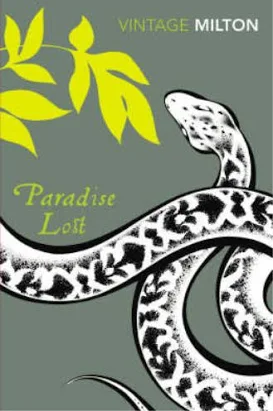
Paradise Lost is something that I’ve wanted to read for years, but I felt that I should probably read all of the Bible first. Since I finally finished it last year, the runway was open for me to finally take on John Milton’s epic poem. It’s probably the toughest text I’ve ever gotten through, but I found it quite a rewarding experience and am glad I read it.
Although I am not a Christian, I find the characters and stories of Christianity very interesting. What Paradise Lost does is retell the story of Adam and Eve being cast out of the Garden of Eden, but in a way that makes the whole of the Bible feel like much more of an epic, inter-connected tale. When you read the Bible, it’s clear that you’re reading a collection of texts that have been written by different people at different times – what Milton has done is help to make it all feel unified, and that is really cool. I’m sure many would consider this a disrespectful comparison, but it feels like reading a really good piece of fanfiction where the author is deeply familiar with the source material – and that is meant as a genuine compliment.
My favourite thing about Paradise Lost is the way that it portrays Satan a.k.a. Lucifer. In the Bible, his history and motivations aren’t very well fleshed out. The Old Testament has him just kind of there causing trouble, but then the New Testament suddenly explains that he is the embodiment of all things evil. In Paradise Lost, meanwhile, he’s a genuinely sympathetic character – he explains that he wants Adam and Eve to eat of the forbidden fruit, because without knowledge of good and evil, they’ll be doomed to an eternity of mindlessly worshipping God and, well, he has a point. He was easily my favourite thing about this epic poem, and probably the best portrayal of Satan I have ever encountered.
On the other hand, while Satan feels much more compelling than he ever did in the Bible, Eve comes across much worse. The problem is misogyny. She was always responsible for the downfall of humanity after being tempted to eat the forbidden fruit, and that itself has often been used to justify negative views on women from within certain religious communities, but in the Book of Genesis, the misogyny didn’t feel too on the nose. Here, you’ve got loads of lines about Eve’s inferior nature and it makes for gruelling reading. You’ve got some colonial attitudes in there as well, which also spoil it.
That’s a curious thing about Paradise Lost, there are lots of references to things that were contemporary to Milton, or to history which would have happened long after the creation of the events of its story. I suppose that comes from a modern perspective of expecting the narrator of a story to be within the perspective of its characters (even if in third-person), but it still feels odd to have references to Portugal during scenes which are supposed to take place before the Earth has even been made.
I much preferred reading Paradise Lost to reading the Bible – it has an almost awe-inspiring feel to it. At the same time, I found it a lot harder to read than the Bible. Sometimes, I genuinely didn’t know what it was saying, but even when I didn’t quite understand, I still thought it was a beautiful piece of writing. If you’re a Christian, or just someone interested in the Bible or Christian religion, I definitely recommend reading it – but only if you have already exercised your muscle for reading classic texts, as it’s not an easy read.
Rating: 8/10