(Don’t miss today’s Finger Puppet Show!)
(Don’t miss my latest article for Rice Digital!)
(Don’t miss today’s Finger Puppet Show!)
(Don’t miss my latest article for Rice Digital!)
(Don’t miss today’s Finger Puppet Show!)
(Don’t miss my latest article for Rice Digital!)
(Don’t miss today’s Finger Puppet Show!)
This is the first time I’ve reported on a death here before, though there have certainly been other times when I thought about it. It was very sad when Ralph Waite died last year and when Joe Conley died the year before him and I was certainly very close to writing about it, but I didn’t feel I’d have anything substantial to say (not that they weren’t equally tragic)
I was surprised by how much the death of Satoru Iwata affected me. It was the first thing I read in the morning and it added a rather downbeat note to the whole day. I wrote a bit about it on the Sellr blog at work today too, by the way. With an actor, you almost feel like you get to know them through their performances, but you wouldn’t expect to get that feeling so much from the CEO of a big company. You wouldn’t expect a death like that to feel like such a personal loss.
But I’ve been thinking about it, and I think I know why. For one thing, he always took the time to do regular Nintendo Direct presentations, where he would announce upcoming games. I’d always be very excited for those presentations and they were purely positive experiences of which he was a big part; those positive experiences will never be the same again. It’s not only that though; the world of video games is something which has remained pretty much unchanged throughout my life; sure, graphics and style might change, but at their hearts, games have remained the same. Iwata has been a part of that, and now things have been irreversibly changed. The chain that went all the way through my life has finally been broken.
I certainly don’t mean to take this terrible thing that happened and make it about me. Of course, I am just a fan of his work, and will not be affected anywhere near as much as his family or the people who actually knew him. Nonetheless, the news of his death has left me quite sad and I wanted to write about it.
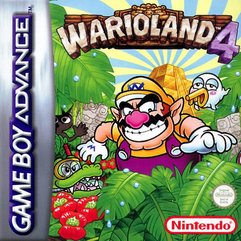
The fourth game in the Wario Land series is a pleasant step up in quality after a temporary dip with the third game. The tone of the series has changed quite significantly with this game, and that may be in no small part due to the fact that it was on the Game Boy Advance.
The game begins with Wario driving off in his fancy new car because he has read in the newspaper that there is treasure to be found in an ancient temple. He gets to the temple and inside there are several portals, these portals take him to various different worlds and these worlds are the game’s levels. You have to go through each one and find certain treasures in order to be able to move on to the next. You are, however, given a lot of freedom in regards to the order you do the levels in.
Something I appreciated was that all of the levels were very distinct. While they all had the same 2D side-scrolling gameplay, it was implemented in a variety of ways. Some levels were traditional cases of ‘go through the level and avoid the enemies’ and other levels were much more puzzle oriented and required you to think about it. As with previous games, there were times where enemies hurt Wario in comical ways and change him physically, which then means he can get past an obstacle. They all had very unique designs too; one level was a deep jungle in the middle of a monsoon rainstorm, another was a creepy abandoned hotel and some were more bizarre, surreal locations, like a pinball world and a domino world. Each and every one of them is full of secrets too.
I mentioned above that there is a significant change in tone with this game and this is something which is hard to clearly convey using words alone. One clear and good example is the fact that Wario is now voiced (and given much more expressive animations) which means you get a greater sense of his character. Meanwhile, all of the games bosses are monstrously hideous, which I find quite funny, but at the same time I do wonder if they might have gone too far with certain boss and enemy designs.
Beyond the main game, you get a selection of bonuses too. There is a ‘Sound Test’ mode which might sound pretty basic, but it’s actually really weird and boarders on avant-garde. There are also three mini-games, my favourite of which is a game where Wario is running along on a ball through a desert and has to jump over everything that gets in his way; it may sound simple but it is very addictive.
On the whole, it was nice to have another great Wario Land game, but I feel like it fails to reach the heights of the first two. The others felt like an adventure, this just felt like a greedy man snooping around looking for gems. Nonetheless, it is very fun and a game I would suggest to you, if you are able to buy it. It’s a solid little title.
Rating: 8/10
(Don’t miss today’s Finger Puppet Show!)
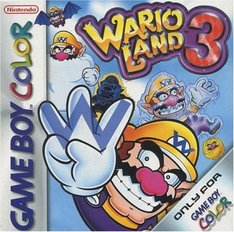
Generally, I like to play the games in a series in the order that they were released. I played Wario Land 3 after playing Wario Land II and I found it quite annoying and anyone else who plays it after the second game might well feel the same. What’s problem? Well, the last two games made a huge point of how big and strong Wario was, with him seeming to get tougher between games, only for this game to suddenly make him much weaker. Wario lacks most of the abilities he had in the last game which is very frustrating when you come across an obstacle and know exactly what needs to be done, but can’t do it because Wario has arbitrarily lost all of his abilities. You slowly get them all back as the game progresses, but it certainly hindered my enjoyment at the start.
Anyway, the game starts with Wario happily flying around in an aeroplane which he then crashes in a jungle. After the crash Wario finds a cave, in that cave is a music box which contains a tiny world; Wario finds himself pulled into that world and then is sent by a mysterious stranger to retrieve parts of another music box which will be used to banish monsters from the world of the music box. It’s an odd story, but I appreciate it for being rather unique.
Rather than having the more simple ‘one level and then the next’ progression that most games in the series have, you play one level, collect an item which will have some effect on the world map (which will open up more levels), go to some of the other levels, get more items, add to the map, return to past levels and so on. It’s very non-linear and getting through the levels actually involves a great deal of puzzle solving and it’s very far from the more normal platforming of the other games. What was very disappointing was that there was a very minimal focus on collecting coins, which is something I always associate with Wario. Also, with no real money focus, getting hit by enemies now has no real negative consequence at all.
It’s a shame that this game feels like such a step down after the first two games were really good. I think that they probably made a conscious choice to try and make the game more open and complex, and that on its own is quite a good idea, but sadly it seems like that was done at the cost of the game being less fun. The music’s quite nice though, and a few of the areas have very nice designs and are quite atmospheric… Just, on the whole, the game felt boring and bland.
Rating: 6.7/10
(Don’t miss today’s Finger Puppet Show!)

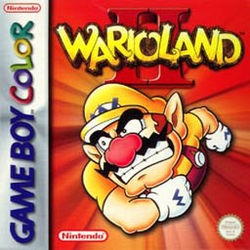
This is the second game in the Wario Land series and also the first time it became wholly distinct from the Mario series. In this game you’ll find no characters from the Mario series (unless you count Wario himself, of course) and even the gameplay is very different. While this may be a disappointment to purist fans of the core Mario series, I certainly view it as a good thing.
Story-wise, you get to see Wario relaxing the castle which he finally earned at the end of the last game. Sadly for him, however, Captain Syrup and the Black Sugar Gang want revenge after their defeat at his hands on Kitchen Island, so they ramshackle the castle and steal his gold meaning he must set out across the world to chase after them and get it back! A simple story, but it’s quite nice because it’s the end of a story that started back in Super Mario Land and spanned five games.
The gameplay is still 2D and side scrolling, but a lot is made of the fact that Wario is really big and tough and there’s also a nice focus on exploration. Wario is actually indestructible now and being hit by enemies merely causes you to drop coins; as Wario is so greedy, you have to collect as many coins as you can to get everything in the game. Furthermore, as Wario cannot be killed, being hurt by enemies often has comical effects on him; he can be turned into a zombie, become hugely overweight, be crushed completely and other over-the-top ailments, all of which can be used to help progress through the levels.
The exploration is very appealing too; the levels are all quite interesting (modern cities, forests, trains, castles) and often have multiple exits. Indeed, this game has branching story with multiple endings! So, even once you’ve gone through the story, there’s a lot of replay value and you’ll enjoy going through the levels again to find alternate endings/exits. Plus, of course, there are secret items hidden in every level and it’s fun to find and collect them all.
So this is definitely worth a try! It’s one of the best Wario games and an all-round fun game with quite a lot of charm to it. The fact that Wario can’t die means that it’s pretty accessible too, as the levels are more about figuring how to get from point A to point B, rather than skilfully avoiding obstacles. Also to bear in mind is the fact that there is a Game Boy and Game Boy Colour version of the game, so it’s best to try and go for the colour version.
Rating: 9/10
(Don’t miss today’s Finger Puppet Show!)